
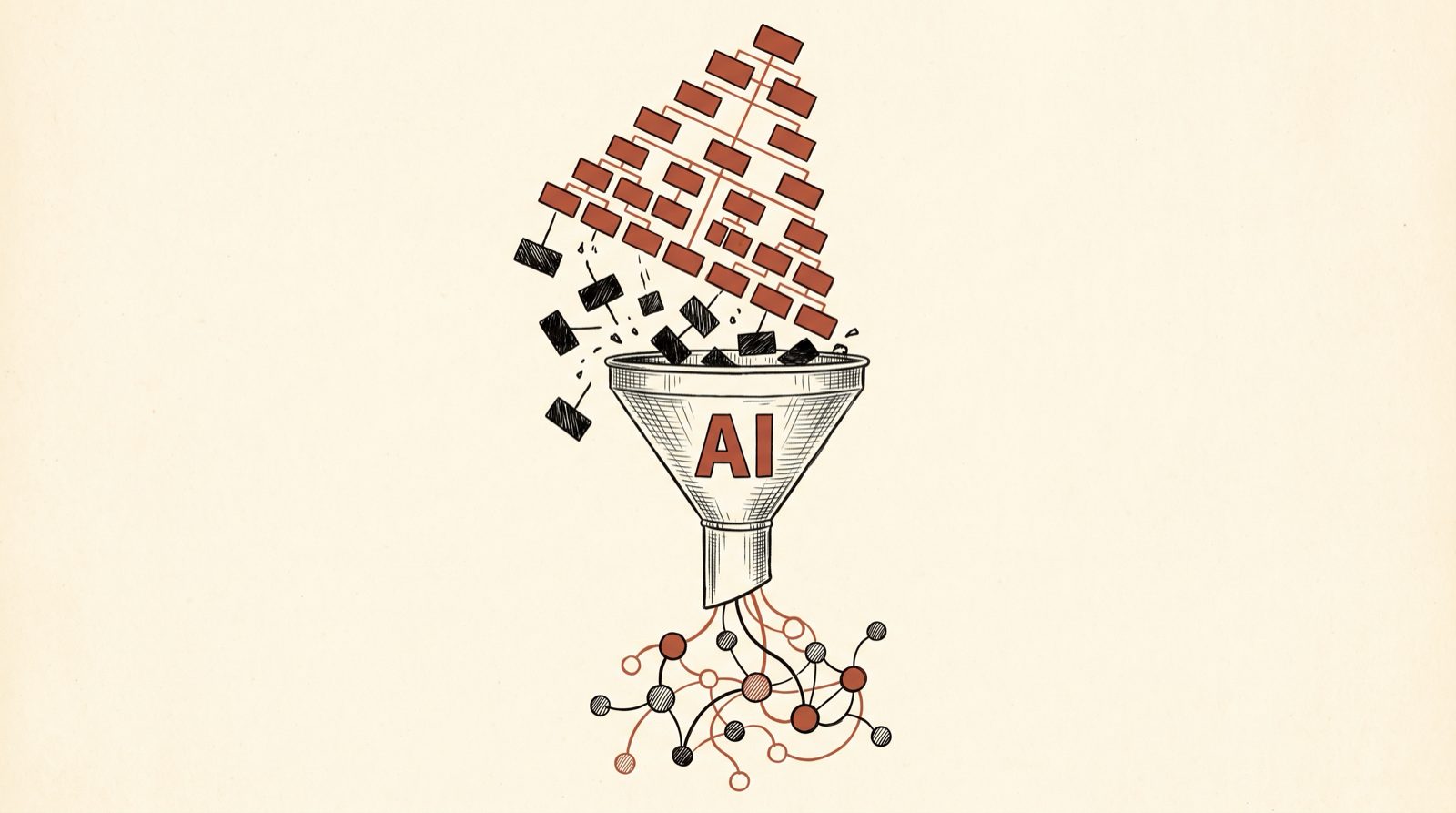
Going AI-native is not the same as switching AI on.
Most companies that say they are adopting AI just bolt it onto the business they already have. Same software. Same meetings. Same org chart, with an AI assistant wired to the side. They count success in logins. So far, the result is a company that costs a little more to run and moves about as fast as it did before — whatever a given team feels. If that is what your AI program bought you, you did not go AI-native. You bought a very smart fax machine.
The fax machine was a real upgrade. It also changed nothing about how the office worked. Bolting AI onto your company works the same way. To get more than a faster fax, you have to change the company, not just the tools it runs on.
AI won't fix your org chart
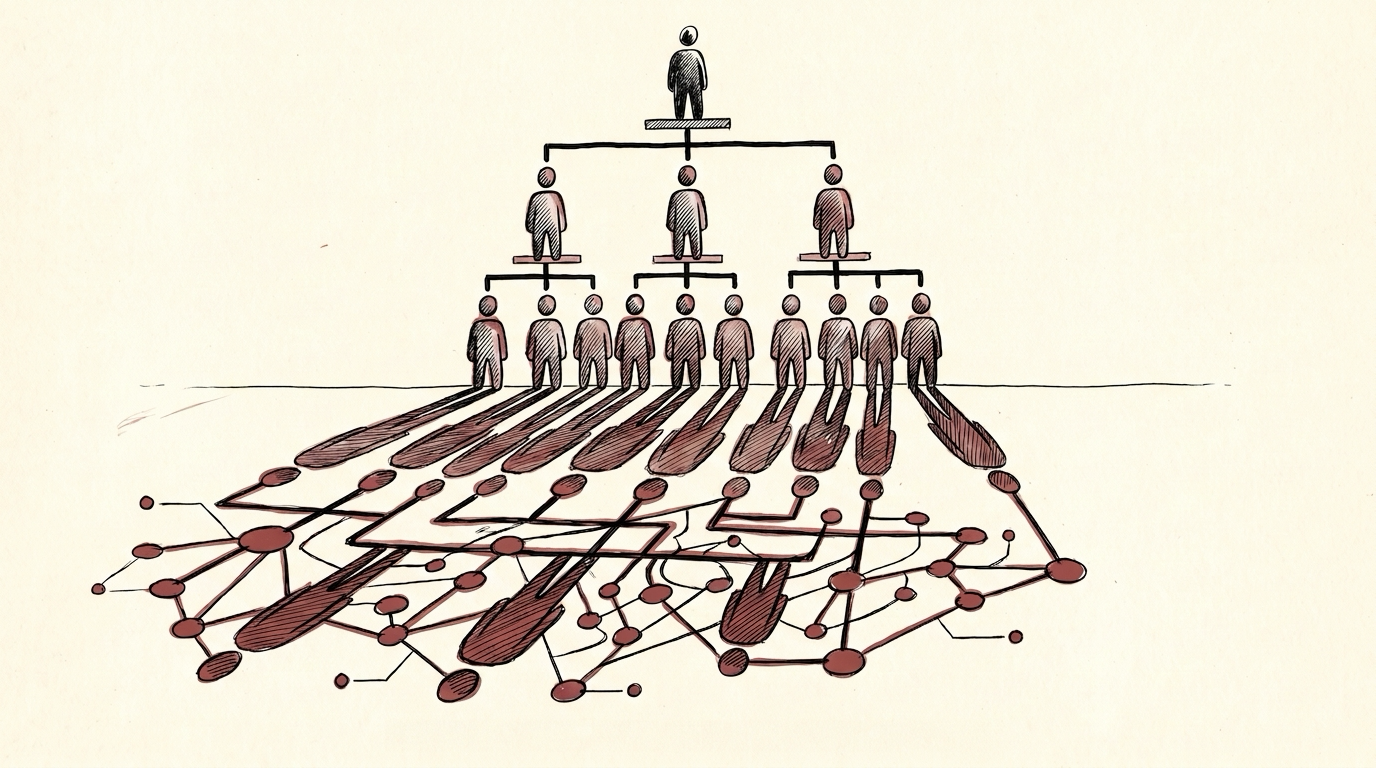
A company leaves its fingerprints on what it builds. How it is organized shows up in the product: who talks to whom, who owns what, how work moves from one desk to the next. There is an old rule about this from software. Conway's Law2 says an organization can only build things shaped like itself. Put plainly: you ship your org chart. If two teams only talk through a formal handoff, the two things they build will meet through a stiff, formal handoff too.
AI does not change this. It just makes the building faster. Point AI at a tangled organization and you get tangled work, now produced at speed. A messy company with AI is still a messy company. It is only messy faster.
So the first thing is plain: AI will not fix your inefficiencies. A faster tool runs on top of the way you already work. It does not redraw it for you. If the company is slow because of how it is built, speeding up the pieces leaves that in place. That is the fax machine again. A different result takes a different organization, and no tool does that part for you.
AI doesn't sharpen skills — it swallows them
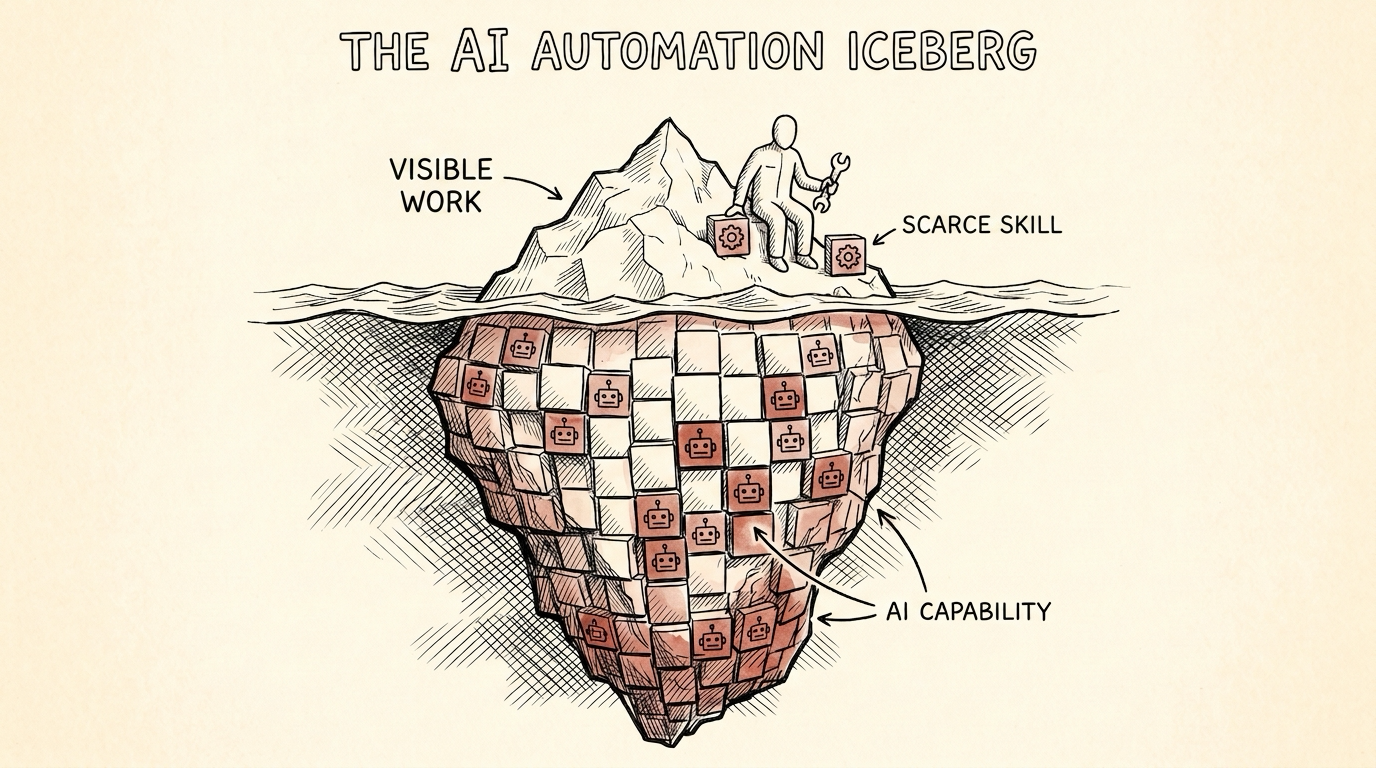
Most AI plans assume AI makes your existing people better at their existing jobs. A power tool for the same work. That is not what happens. AI does not sharpen a skill. It swallows it. The skill that used to be rare and valuable becomes something anyone can buy cheaply.
This is not new. It is what every important tool has done. The master craftsman spent a decade learning a trade by hand. Then the factory made that skill routine, and the value moved to whoever could design the production line. The same thing happened to programmers who could squeeze speed out of a machine by hand, until better tools did it for them. Each time, a hard-won skill turns cheap, and the people who built their careers on it feel the ground move.
A recent MIT study puts the current version well: AI automates skills, not jobs.1 Any job is a bundle of skills. AI picks them off unevenly. It takes some, helps with others, and leaves the rest. So the change happens inside a job long before the title on the chart changes. The software coding everyone points to now is just the visible tip, about two percent of the economy's wages. The larger mass sits out of sight: the every-day thinking that runs finance, operations, administration, and the professions.
If a job is mostly a container for one skill, and AI swallows that skill, the job is mostly hollow. What is left is not the skill. It is the judgment around it.
What's left is judgment
Building used to be the expensive part. Writing the code, making the draft, producing the thing: that took time and a scarce skill. AI drives that cost toward zero. When the expensive part of a job gets cheap, the bottleneck moves to whatever is left. What is left is judgment.
Judgment is the part that decides what to build. It breaks the work into sensible pieces and defines what "good" even means. Then it checks the result. That last step is the one the AI sales pitch skips. Describing what you want without checking what came back is just guessing with extra steps.
And the checking matters more with AI, not less. AI is excellent at producing work that looks right. Whether it is right is a separate question, and the tool cannot answer it about itself. Plausible and correct are not the same thing. The gap between them is where the trouble lives. A confident but wrong draft, waved through fast, is how accidents happen. Someone has to be able to tell real quality from a convincing fake.
So the scarce skill is no longer doing the work. It is judging it. That changes who is valuable. The old bar was deep technical credentials. The new bar is judgment: understanding the business, saying clearly what needs to happen, and knowing good work when you see it.
Reorganize, or buy a fax machine
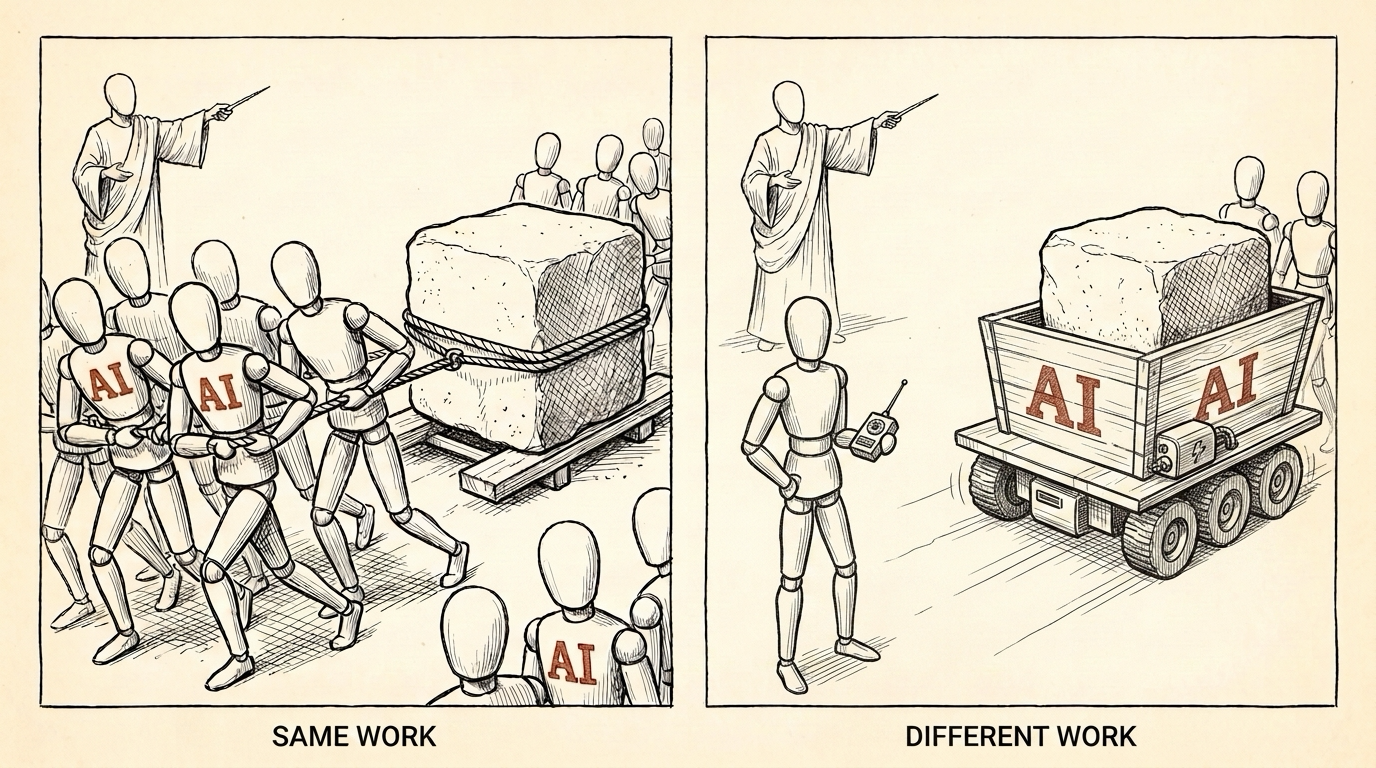
The three points meet here. AI makes building cheap. It swallows the skills that used to fill jobs. What stays valuable is judgment. And a company can only be as good as its scarcest input. When building was the bottleneck, the strong companies organized around builders. Now judgment is the bottleneck, so the strong company organizes around judgment. Hand AI to the people you already have and keep the same chart, and your scarce resource stays buried under task-work. The work has changed, so the shape has to change with it.
In practice, that means organizing around jobs that lead with judgment instead of jobs that were mostly task-work. The people who decide and check move to the center. The roles that existed to carry a now-cheap skill get thinner, or fold into something else. That is a different org chart. And that reshaping — not the tools bolted on top — is what changes the result.
This is why AI-native is an organizational change, not a software one. You can buy the tools in an afternoon. Reshaping the company around them is the actual work, and no vendor sells it. There is a test in this. If the companies that reshape around AI end up no more effective than the ones that only bolted it on, the argument fails.
So the real question is not "have we adopted AI." Everyone will say yes. The narrower one is this. Are you reorganizing the business around what AI now does cheaply? Or just bolting it onto the business you already had? If it is the second, you have not started. You have a very smart fax machine.
-
MIT Media Lab, Iceberg Index (Project Iceberg), arXiv:2510.25137 (October 2025); iceberg.mit.edu. The study models AI's exposure across skills rather than jobs, putting roughly 2.2% of wage value in the visible "tip" against a far larger submerged mass — about 11.7% — below the waterline. ↩
-
Melvin E. Conway, "How Do Committees Invent?", Datamation (April 1968); author-hosted at melconway.com. ↩

About the Author
James Dixson has been an engineering leader, building software products and teams for over 30 years. → About me